What is %radio?
%radio is an application I made while working at a VC firm with an interest in Urbit, a platform that helps ordinary people run services (ordinary people typically only run clients).
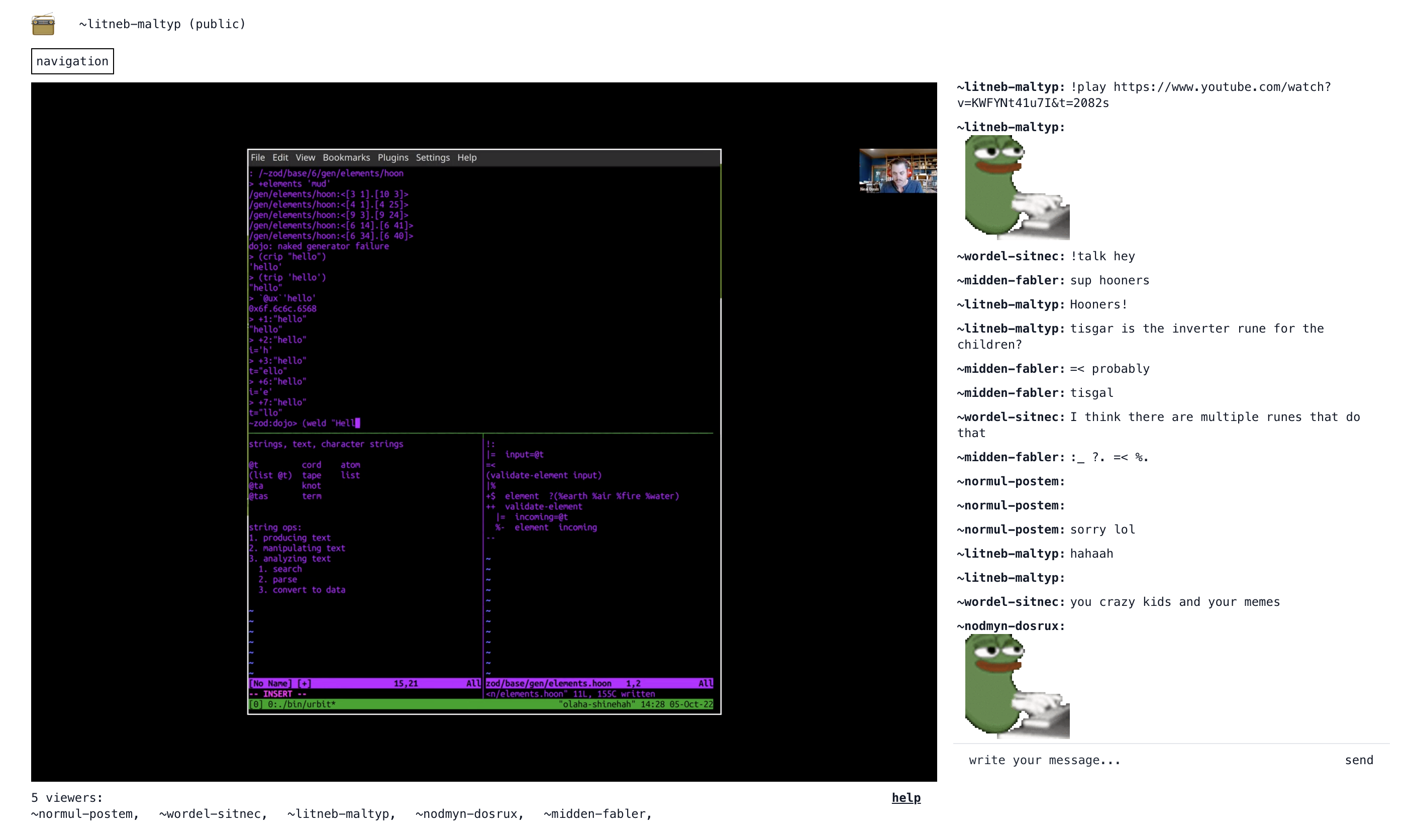
some people hanging out on %radio while learning a new programming language together
Everyone who used %radio automatically hosted their own real time watch party chatroom from their own personal server. It was the only Urbit app that showed who else was online with you. Urbit users tended to really like %radio over other apps, I think because the real time presence made the platform feel much more alive. At its peak, the largest room on %radio hosted over 100 simultaneous chatters. 100 people is a tiny number in internet terms, but in Urbit terms, 100 people in one place at one time was like the Super Bowl, lol.
Urbit has a reputation for being slow and buggy. Several people, after trying %radio for the first time, were so surprised by its performance that they assumed the real time chat was hosted as a normal web service outside of the Urbit platform. It wasn't! The backend for %radio was 100% on Urbit, running on each users personal server. %radio didn't have any performance tricks. It was fast because it was simple; most other things on Urbit were complicated. And every user really did host their own %radio chatroom on their Urbit server. If a user did anything I didn't like in their own chatroom, there was nothing I could do about it. I'm happy to say that nobody abused this privilege.
radio.gtim.xyz
The %radio app on Urbit is no longer maintained, but the repository has still just been sitting there on my GitHub with a lot more stars than any other repos on my profile. Lately when I look at GitHub and see the %radio repo, I cringe a little bit. The code is not my finest work, lol. It was one of the very first web app frontends I ever made. So, for the sake of the new people I meet who want to check out my GitHub, I wanted %radio to be more than just a pile of old code. Today I took a few hours to memorialize %radio by repurposing the backend to be hosted as a normal web service. You can click here to try it.
The frontend is mostly identical to how it looked on Urbit. And users are given Urbit names (like ~sampel-palnet) to preserve that style too.